

Table of Contents
- Why Transparent Supplement Brands Are Worth Your Money
- What to Look For in Supplement Brands With Full Ingredient Disclosure
- Creatine Monohydrate: The Single-Ingredient Benchmark
- Protein Powders for Muscle Recovery and Growth
- Pre-Workout and Stimulant-Free Performance Support
- Why Third-Party-Tested Supplement Brands Matter
- Best Supplement Brands for Bodybuilding: What Separates Them
- Where to Buy Fitness Supplements Online: What to Check Before Checkout
- Frequently Asked Questions
Last Updated: October 16, 2026
Why Transparent Supplement Brands Are Worth Your Money
When you shop transparent fitness supplement brands, you are paying for information as much as for powder.
At Bionic Supps, we have spent 12 years in the nutrition industry, and we have watched the same pattern repeat. The FDA's guidance on dietary supplement labeling sets the rules for what must appear on a Supplement Facts panel, but it does not force a brand to disclose every ingredient amount.
Transparency is not a badge, it is a testable claim. Here is how to run that test on any brand, including ours.
Proprietary Blends vs. Full Label Disclosure
A proprietary blend lists ingredients together with one total weight, so you cannot tell how much of each one you are getting.
A blend can legally contain a large dose of a cheap ingredient and a token amount of the one you wanted.
The practical test takes ten seconds: find the Supplement Facts panel, look for the word "blend," and check whether individual amounts are printed next to each ingredient.
What to Look For in Supplement Brands With Full Ingredient Disclosure
Supplement brands with full ingredient disclosure share four habits: every ingredient amount is printed, serving size is stated in grams, servings per container is listed, and the label matches the product page.
Here is the checklist we would run on any brand, ours included:
- Every active ingredient has its own milligram amount, not a blend total
- Serving size is given in grams or scoops, and the scoop weight is stated separately
- Servings per container is printed, so you can calculate cost per serving
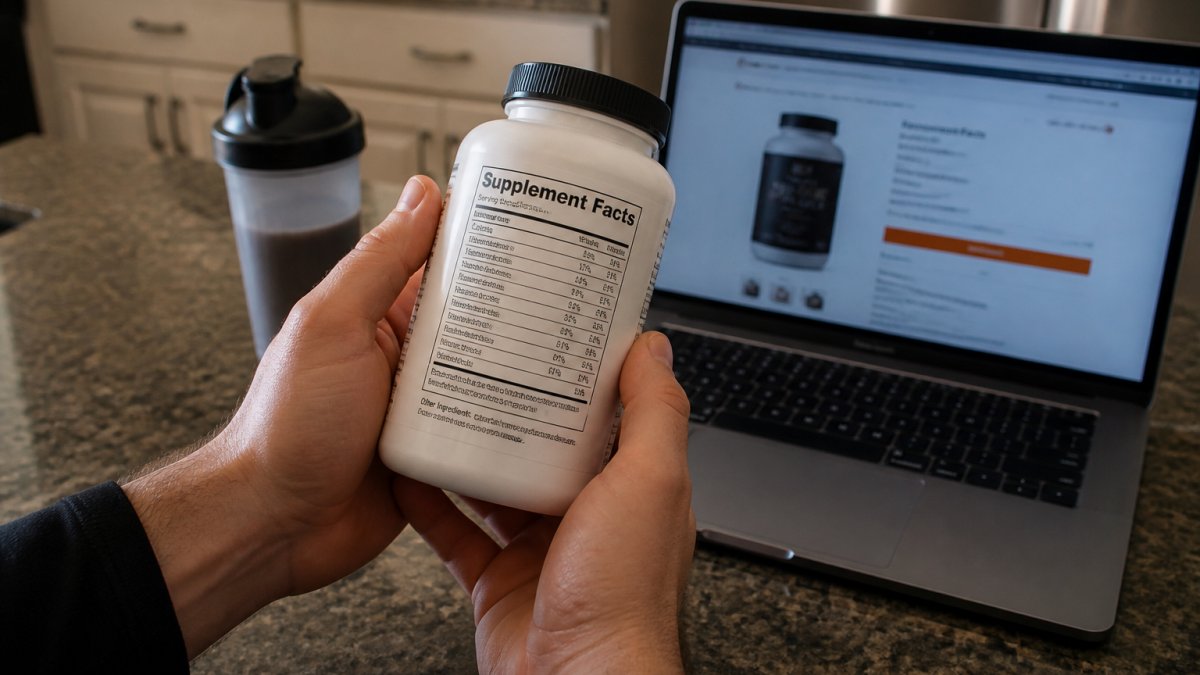
Creatine Monohydrate: The Single-Ingredient Benchmark
Creatine monohydrate is the easiest supplement to judge, because a good version has exactly one ingredient.

Our Creatine Monohydrate is built to that standard: 5,000 mg per serving, one 5.6 g scoop, 50 servings at $33.90, well under a dollar per serving, with the full Supplement Facts label on the product page.
Cost per serving, not sticker price, is the number that matters. A cheaper tub with 30 servings can cost more per workout than a larger one with 50.
| What to Check | Why It Matters | Bionic Supps Creatine Monohydrate |
|---|---|---|
| Ingredient count | Single-ingredient means nothing to hide | Creatine monohydrate only |
| Dose per serving | Needs to match the studied amount | 5,000 mg per serving |
| Servings per container | Drives true cost per serving | 50 servings |
| Price | Compare per serving, not per tub | $33.90 |
| Label access | You should see it before buying | Full label on product page |
Protein Powders for Muscle Recovery and Growth
Protein powder is where label reading gets harder, because flavoring, sweeteners, and mixability ingredients crowd the panel.
Our whey protein isolate comes in two flavors, both with full formula disclosure. The vanilla and chocolate versions each provide 22 g of protein per two-scoop serving, with 24 servings at $49.90.


"Isolate" is a processing claim, not a dose claim. You still have to check grams of protein per serving and servings per container, a 24-serving tub at two scoops per serving is a 12-day supply if used daily.
Pre-Workout and Stimulant-Free Performance Support
Pre-workout is where transparency matters most, because caffeine content varies wildly and "proprietary energy matrix" tells you nothing.
Our Energy Powder in fruit punch takes that approach: 200 mg of caffeine from green tea per two-scoop serving, plus L-theanine, taurine, B vitamins, and minerals, with 20 servings at $34.99.
For stimulant-free support, we point people to Beetroot Powder: beet root, hibiscus, and apple juice powders sweetened with stevia, $35.90 for 30 servings, with no caffeine, usable in the evening or alongside a caffeinated pre-workout.
Why Third-Party-Tested Supplement Brands Matter
Third-party-tested supplement brands send finished products to an outside lab to confirm that what is on the label is what is in the bottle. The NSF Certified for Sport program and USP Verified Mark are two recognized independent verification programs in this space, and both publish what their testing covers.
But the logos do not all mean the same thing. Here is what each program actually verifies, and what it does not.
What Third-Party Testing Actually Verifies
A finished-product test typically checks four things:
- Label accuracy, does the bottle contain the ingredients and amounts printed on the panel?
- Contaminant screening, are heavy metals, microbes, or solvents below established limits?
- Banned-substance screening, are substances prohibited in sport absent from the product?
What testing does not verify is whether the dose is large enough to do anything. A product can pass every test and still contain 200 mg of an ingredient studied at 2,000 mg. Testing answers "is this what the label says?" not "is this label worth buying?" You need both checks, verified contents and studied doses, before a product earns your money.
How to Tell Documented Evidence From Marketing Claims
"Third-party tested" and "lab verified" are not regulated phrases, any brand can print them. To separate a documented claim from a marketing one, look for a specific, checkable detail:
- A named certifying body (NSF, USP, Informed Sport, BSCG) rather than a generic phrase
- A certificate of analysis (COA) you can request, showing the lab name, the test date, and the batch number
- A batch or lot number on the tub that matches the COA
If a brand cannot tell you who tested the product, when, and against what standard, treat the claim as unverified.
How to Verify a Testing Claim in Five Minutes
- Find the certification logo or testing statement on the product page.
- Search the certifying body's own website for the brand or product name, most publish a searchable list.
- If the brand offers a COA, request it and check that the batch number matches the tub you received.
- Confirm the scope: does the certificate cover the full label, or only contaminants?
Where Our Own Labels Stand
We are direct about this: not every product we sell carries a third-party certification mark, and we do not pretend otherwise. What we do provide is full label disclosure on every product page, every ingredient amount printed, serving size in grams, servings per container, allergens and sweeteners named, so you can run the dose check yourself. If a certification is the deciding factor, ask us which products carry one.
Best Supplement Brands for Bodybuilding: What Separates Them
The best supplement brands for bodybuilding do three things consistently: they print full doses, keep single-ingredient products genuinely single-ingredient, and price by serving rather than tub size.
But "best brand" is the wrong question. A brand that makes an excellent single-ingredient creatine may make a mediocre pre-workout. The useful question is: which brand is best for the specific product I am buying, at the dose I need, at a price per serving I can justify?
Compare by Cost Per Serving, Not Sticker Price
Cost per serving is the only price number that lets you compare two tubs fairly:
Price ÷ servings per container = cost per serving
A $30 tub with 30 servings is $1.00 per serving; a $50 tub with 60 servings is $0.83, cheaper per use despite the higher sticker price. Brands that want to look inexpensive often shrink the serving count rather than the price.
Here is how our four core bodybuilding products compare on that basis:
| Goal | Product | Key Numbers | Price | Servings | Cost Per Serving |
|---|---|---|---|---|---|
| Strength support | Creatine Monohydrate | 5,000 mg per serving | $33.90 | 50 | $0.68 |
| Muscle recovery | Whey Protein Isolate, vanilla or chocolate | 22 g protein per two-scoop serving | $49.90 | 24 | $2.08 |
| Performance support | Energy Powder, fruit punch | 200 mg caffeine per serving | $34.99 | 20 | $1.75 |
| Post-workout recovery | BCAA Powder, honeydew/watermelon | 4,000 mg BCAAs + 1,000 mg L-glutamine per serving | $35.90 | 45 | $0.80 |
Two things stand out. Creatine is the cheapest per serving by a wide margin, which is why it is the first supplement most lifters should buy.
Match the Product to Your Goal, Not the Marketing
A bodybuilding stack usually comes down to four purchases:
- Muscle gain and strength, creatine monohydrate is the most-studied strength supplement, and a single-ingredient version is the easiest to verify. Look for 5,000 mg per serving.
- Muscle recovery and daily protein, whey isolate delivers protein with less lactose than concentrate. Check grams of protein per serving and servings per container, because a two-scoop serving halves your tub life.
- Training performance, a pre-workout with a stated caffeine amount (in milligrams) and a named caffeine source is more useful than one with a "proprietary energy matrix." If you train late or are caffeine-sensitive, a stimulant-free option is the better pick.
Dietary Needs and Who Should Skip What
Transparency also means telling you when a product is not for you:
- Dairy allergy, whey isolate is still a dairy product. "Isolate" means less lactose, not dairy-free. If you have a milk allergy, choose a plant-based protein instead.
- Caffeine sensitivity, a 200 mg caffeine pre-workout is roughly two cups of coffee. If you are sensitive, pregnant, or training in the evening, use a stimulant-free product.
- Artificial sweeteners, sucralose and acesulfame potassium are common in pre-workouts and BCAAs. If you avoid them, check the sweetener line before ordering.
Stacking Without Double-Dosing
When you stack products, add up the overlapping ingredients. Caffeine is the most common overlap, a pre-workout plus a caffeinated fat burner plus coffee can push you past a sensible daily amount. Creatine rarely overlaps; protein overlaps with bars and shakes. Before you stack, list every active ingredient across every product and check the totals against the label directions.
Where to Buy Fitness Supplements Online: What to Check Before Checkout
Where to buy fitness supplements online comes down to three checks: the seller shows the full label, states shipping terms clearly, and makes returns or questions easy to resolve.
A few habits worth building:
- Compare cost per serving across sizes, not the listed price
- Confirm the seller lists allergens and sweeteners on the product page
- Check whether free shipping thresholds apply before you fill a cart
We ship free on orders of $50 or more, which covers most two-product stacks. Every product page carries the full label, ingredients, directions, and warnings, so the decision happens before checkout.
Frequently Asked Questions
How can you tell whether a supplement brand is transparent?
Check whether the label lists exact ingredient amounts per serving rather than grouping them under a proprietary blend. A transparent supplement brand will also publish a full Supplement Facts panel on its product page, state the serving size and servings per container, and disclose allergens and sweeteners. Bionic Supps, for example, shows 5,000 mg of creatine monohydrate per scoop, 22 g of protein per two-scoop serving, and 200 mg of caffeine per energy powder serving.
Are third-party-tested supplements better than ones without testing?
Third-party testing adds a layer of verification that what's on the label matches what's in the bottle. It doesn't guarantee a product works better, but it reduces the risk of contamination or underdosing. When shopping, look for brands that publish testing details or certifications. If a brand doesn't mention testing at all, that's a gap worth noting before you buy.
What should I look for when buying fitness supplements online?
Start with the product page: does it show the full Supplement Facts label, exact ingredient amounts, serving size, and allergen warnings? Then check the price per serving, not just the sticker price. A $33.90 creatine with 50 servings costs about $0.68 per serving, which is a more useful number than the total. Also confirm shipping terms, return policies, and whether the brand has a track record you can verify.
Are transparent supplement brands more expensive?
Not necessarily. Full-disclosure formulas can cost more per container because they use higher doses of tested ingredients, but the cost per serving often lands in a similar range to mass-market options. For example, Bionic Supps creatine monohydrate is $33.90 for 50 servings. When comparing, divide the price by the number of servings to get a real picture of value.
What supplements should a bodybuilder prioritize from a transparent brand?
The core stack is creatine monohydrate for strength support, whey protein isolate for muscle recovery and daily protein intake, and a pre-workout or energy powder for training sessions. Bionic Supps covers all three: creatine at $33.90, whey isolate at $49.90, and energy powder at $34.99. Add a BCAA post-workout powder or beetroot powder if recovery and hydration are priorities.
The hard part of buying supplements is not finding products. It is finding a seller who shows you enough to judge them. Bionic Supps publishes full labels, ingredient amounts, serving sizes, and directions on every product page, backed by 12 years in the nutrition industry. Start with our Creatine Monohydrate or build a full stack, and get free shipping on orders of $50 or more.